

Essay Writing: The Five-Paragraph Myth
In our educational journey, we likely learned some myths about writing. One pernicious myth is the bane of many college English professors' existence: the belief that writers should always employ the five-paragraph essay template—a rigid model compelling the writer...

Transitions: Improving Clarity and Logical Flow
Using transitions to improve clarity and logical flow is essential, whether we are meticulously drafting a legal brief or lengthy proposal or dashing off a short email or tweet. In either case, transitions enable a reader to follow the writer’s train of thought as...
Hyphens, Em Dashes, and En Dashes: When to Use Them and How to Type Them
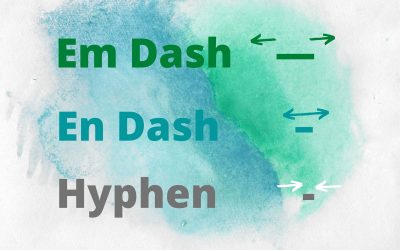
The hyphen, the em dash, and the en dash are all horizontal marks of varying lengths. Each functions differently from the others. Below we define each mark, explain when to use them, and provide instructions for typing them on both PCs and Macs. (View our new...

Can a Sentence Start with AND or BUT?
One of our subscribers wrote to ask about starting sentences with and or but. She wondered whether it is considered grammatically correct to do so. The answer is yes. The operative word here, though, is sentences. Notice the difference between these two examples: Two...

Parallel Structure
Whenever our writing includes a list, the items in that list need to be parallel with one another. That is, all of the items in a list must be the same, both logically and grammatically. Logically Parallel Lists First, the items in a list must be parallel in meaning....

Irregardless
I could sum up my advice on this word in a single sentence: avoid using irregardless, especially in professional contexts. Although you will often hear and read the word irregardless, it is considered substandard, largely because it is illogical: that is, regardless...

Ellipses
An ellipsis consists of either three or four periods, or dots. A single dot is called an ellipsis point. The definition is pretty straightforward, but using ellipses can be tricky. Writers use ellipses for various reasons. An ellipsis can indicate the omission of...

Comma before AND (and Other Coordinating Conjunctions)
If the number of page visits is a reliable indicator, this topic—using a comma before and—is on the minds of many people. The third most oft-visited on this site, this page garnered close to 10,000 hits in the past thirty days. (The most popular page—with twice as...

Neither, Either, and Each: Three Tricky Indefinite Pronouns
In a different post, we discuss using singular personal pronouns to refer to singular indefinite pronouns (e.g., anyone, everyone, someone) and pointed out ways to do so without reinforcing the gender binary. This article focuses on making verbs agree with the...